Orbit · Side project · Public beta ended
A dating app where your profile lasts one day and you talk to five people.
Orbit is a dating app I designed and built on my own. Everyone gets a random color-and-animal name instead of a username, profiles reset every day, and each person can have up to five people in their orbit. It reached a public beta with fewer than 1,000 users in Atlanta. The beta has ended, and there hasn’t been a public launch.
- Role
- Solo. I wrote the press release and FAQ, the voice guide and the developer spec, then designed and built the app, with AI coding agents working through the build phases I planned.
- Users
- Fewer than 1,000 people in the Atlanta public beta
- Timeline
- June 2025 – March 2026, from the first concept documents to the latest rewrite
- Status
- The beta has ended. No public launch.
The problem
Dating apps reward endless browsing.
I started with an Amazon-style press release and FAQ, written before any code. It named five problems with online dating: endless swiping and decision fatigue, stale profiles from people who stopped using the app, over-polished profiles, ghosting, and apps that collect more personal data than they need.
Each problem got one rule in response. If you can only pick five people a day, you have to choose. If every profile expires within a day, everyone you see was active today. If a profile is one selfie and a short headline, there’s little to polish.
The rules
Four constraints shape the whole product.
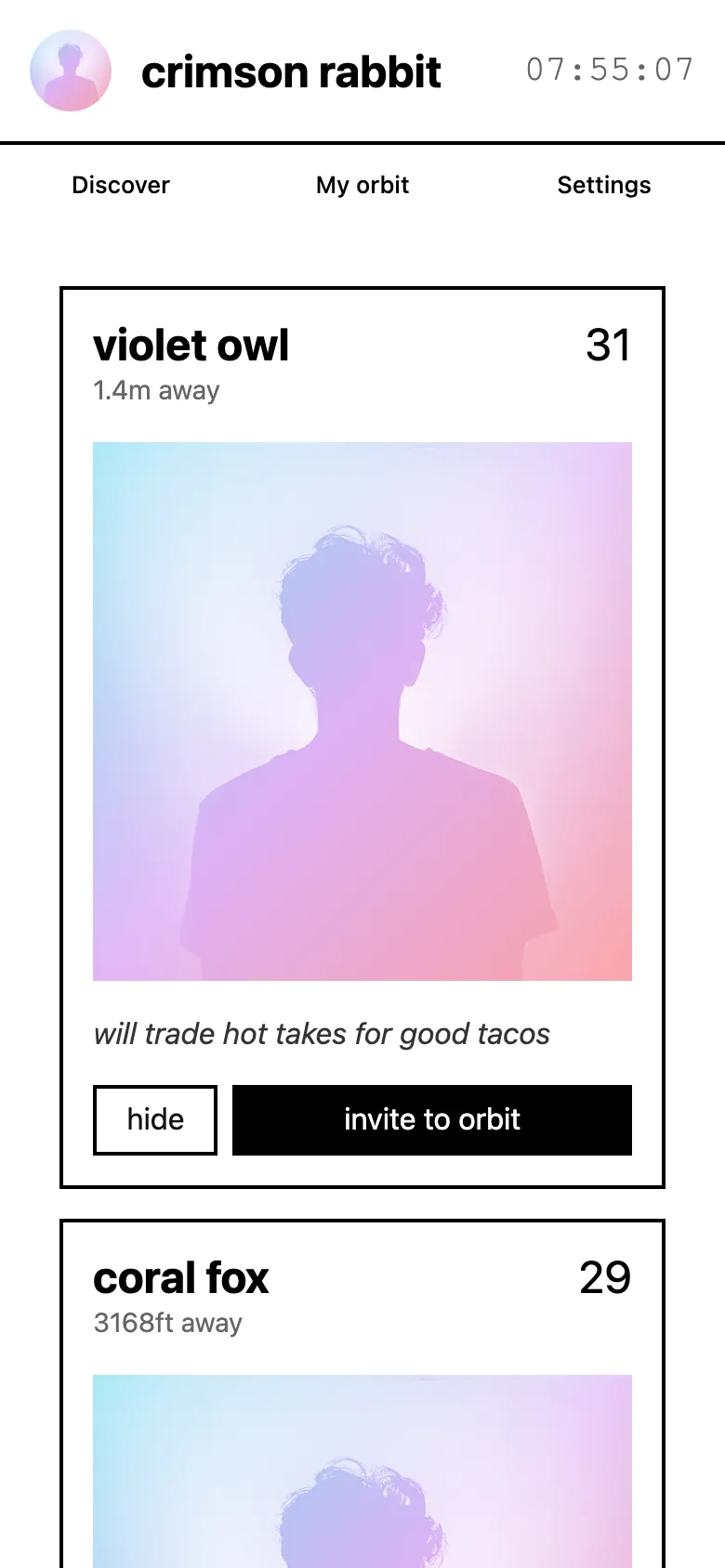
Profiles last a day. The press release set a 24-hour session from sign-up. In the build, everyone resets together at local midnight, and the header counts down to it.
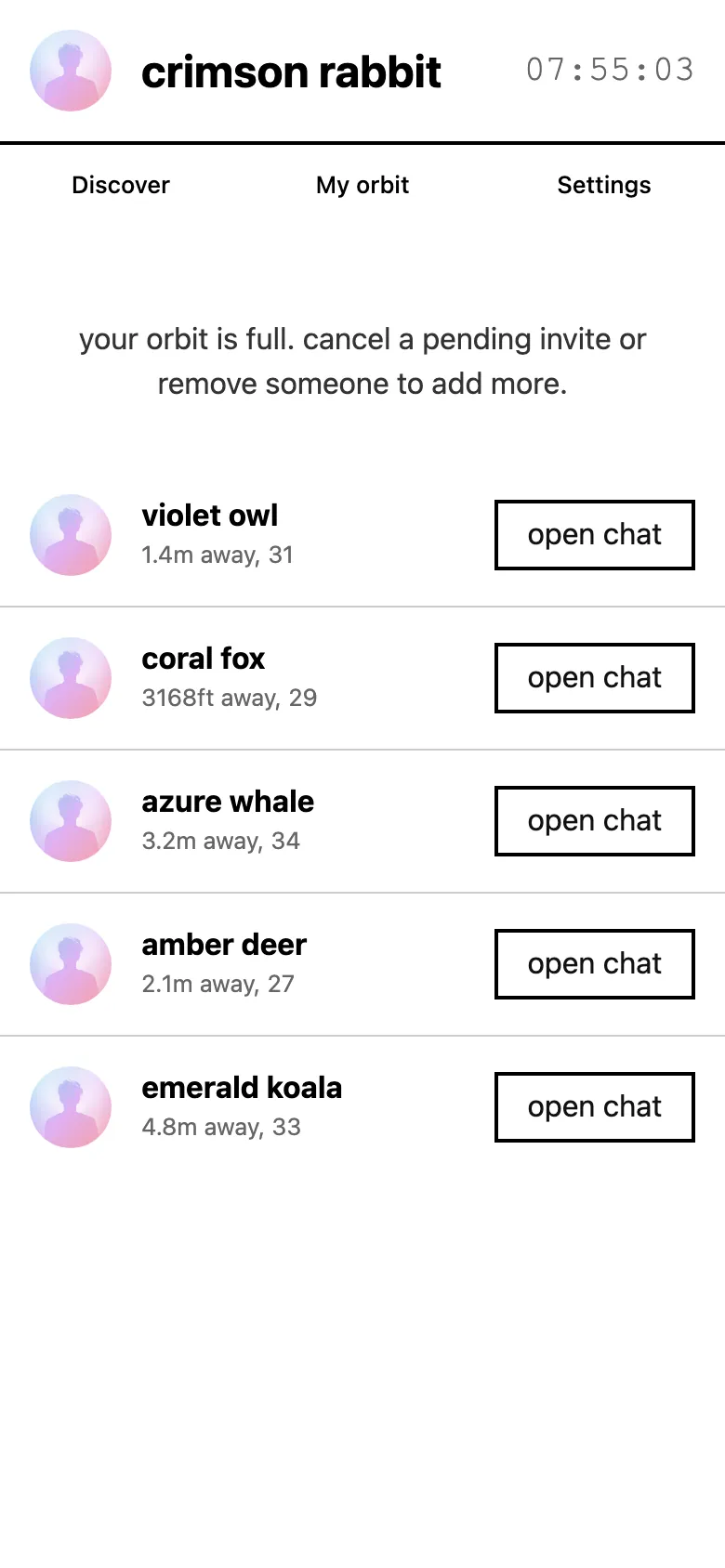
Five people at a time. Your orbit holds up to five people. When it’s full, you can’t invite anyone else, and you stop appearing in other people’s Discover feeds until the reset.
No names. When you create a profile, Orbit gives you a codename made of a color and an animal, like “coral fox.” It’s the only name anyone sees, and it has to be unique within 100 miles of you.
No swiping. To connect, you send an invitation with a short message of up to 140 characters. The other person accepts or doesn’t. The only other action on a card is “hide,” which lasts until the reset. The press release promised no algorithms; the build does rank Discover, by a match score from sun-sign compatibility and distance.
Voice
I wrote a voice guide before the first screen.
The guide describes Orbit as “bold and weird,” “emotionally available (but not mushy),” and “minimalist and suggestive,” and it lists words to avoid: swipe, match, profile, algorithm. Some of the lines it gives as examples:
“You’re not a name. You’re a Violet Lizard.”
“This app will not fix you. But it might feel nice for 24 hours.”
Inside the app, the copy is quieter. The guide asks for “one good line per screen” during onboarding, and a separate content style guide keeps errors and limits plain. The welcome screen says “See who’s out there.” The selfie step says “Snap a picture that would make your parents proud.” The sign-in screen says “we won’t store your number beyond today.” When the feed is empty, it says “No one nearby right now. Check back later.”
The screens
Black and white, with color only in the photos.
The interface is black rules, white cards and lowercase text, so the photos and codenames are the only things that stand out. The codename is the largest type on every card. The countdown to midnight stays in the header on every tab, so the daily reset is always in view.
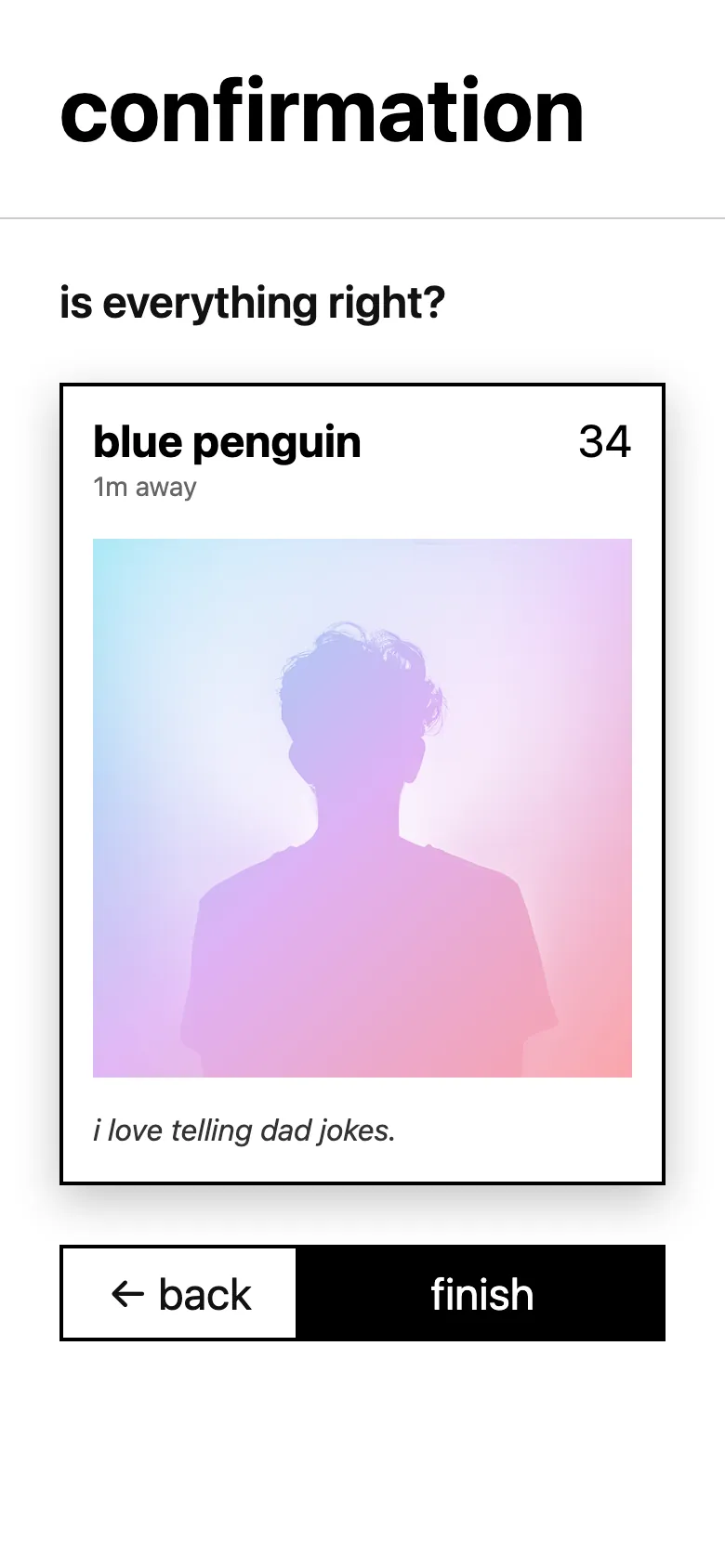
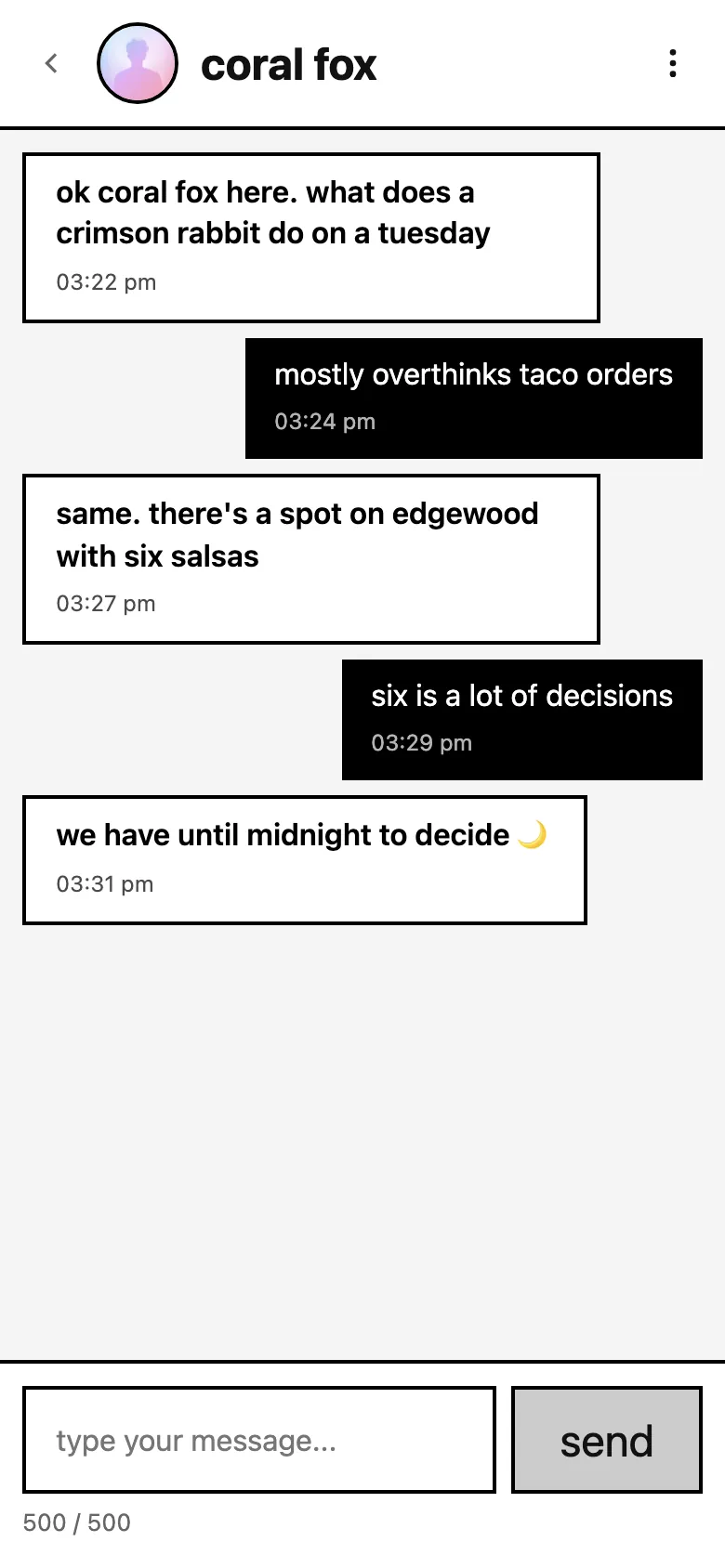
Chats have their own rules. Either person can end a chat. Only the person who ended it can resume it that day; the other person sees “chat ended.” Messages are text and emoji only, up to 500 characters. Selfies can only be taken with the in-app camera, not uploaded.
Options considered
Two places where I chose against the default.
While writing the requirements, I worked through a decision checklist for each part of the app, with a recommended option for every item. Most items took the recommendation. These two didn’t.
The beta
It ran with fewer than 1,000 people in Atlanta, then ended.
Orbit reached a public beta with fewer than 1,000 users in Atlanta. The September build includes a beta-feedback form in Settings that saves reports for me to review. The beta has ended, and I haven’t had time to return to a public launch.
I don’t have numbers to report on retention, invitations or conversations. The beta showed that the product could run with real people in one city. It didn’t show whether the five-person limit and the daily reset make dating better.
Since then I’ve started a rewrite on Next.js and Supabase. It keeps the five-person orbit, the codenames, invitations with a message, and the reset at local midnight. It hasn’t launched.
Next case · The Home Depot