Many Hats + The Design Dash · Agentic product work
AI agents prepare and challenge the work. A person approves it.
Every time I handed work to a general-purpose AI agent, it came back to me for the specialist judgment. So I designed a system for it: specialist roles, shared facts, a critic who challenges the work without being responsible for delivering it, and a clear line where the human approves.
Side project · open source- Role
- Creator. I designed the role boundaries, approval model, skill architecture and planning method.
- Users
- Designers and builders doing AI-assisted product work, solo or in a team
- Status
- Public v0.1, used daily at Renaissance, at Green Loom and on this portfolio
- Outcome
- Substantive issues caught before human review rose from 3 to 8 per project
The problem
Every handoff came back to me.
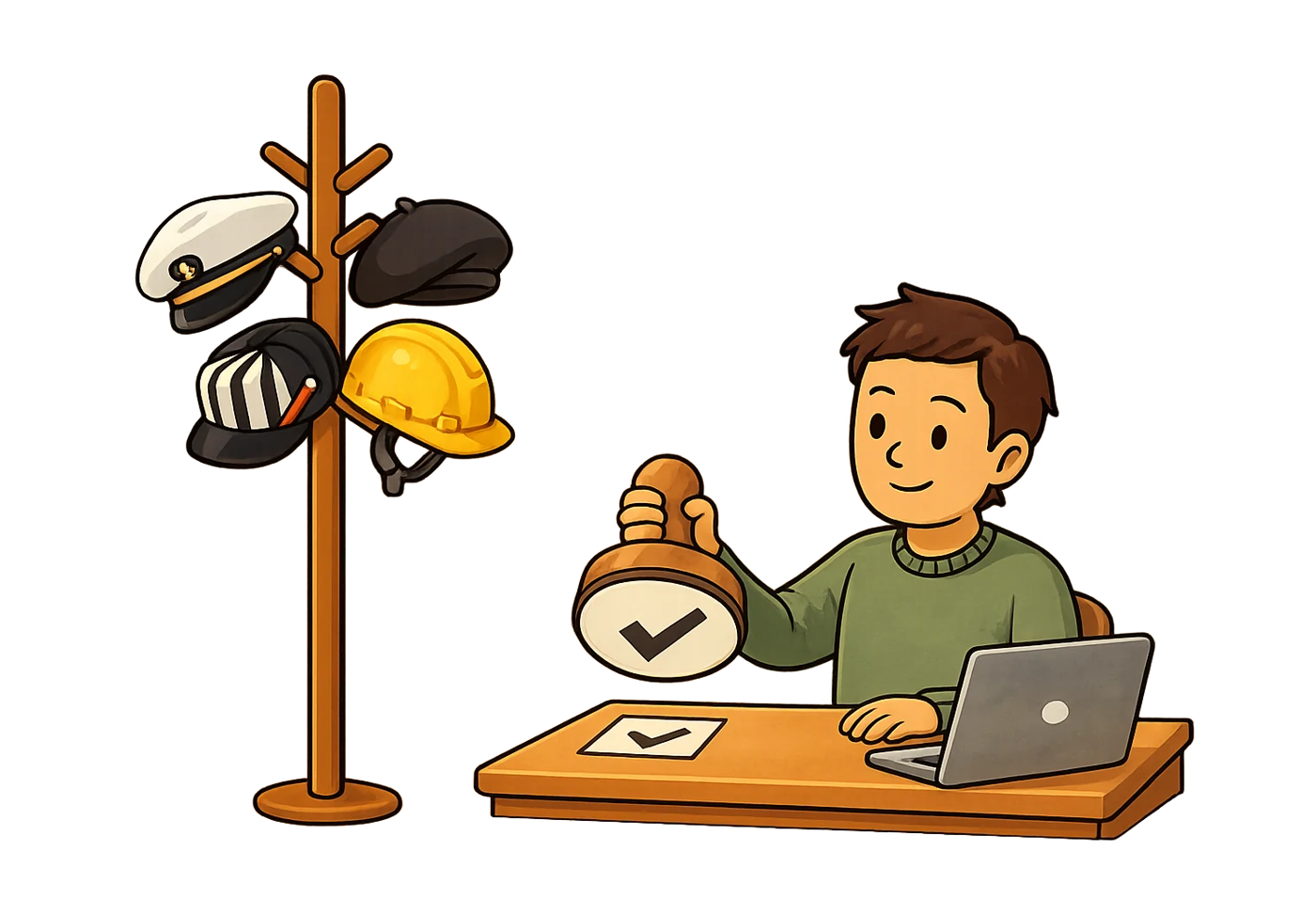
My workflow was to draft a plan, polish it with a general-purpose agent, and hand pieces to general-purpose sub-agents. The output looked finished. But I still had to bring the specialist review myself: the domain model, the flows, the language, the risks. A polished result was hiding reasoning nobody had finished.
The danger wasn’t bad output. It was output that looked done when the decisions hadn’t been made.
The real design question was about trust and accountability. When should an agent act on its own, when should it only recommend, and how does a person see what they’re approving?
Options explored
How much should one agent own?
Key decisions
Design the boundaries, not just the prompts.
Separate the role from the project
Stable roles, reusable skills, shared knowledge and project deliverables live in separate layers, so one project’s fix can’t quietly rewrite everyone’s rules.
A critic who doesn’t deliver
Allie challenges the plan without having to defend it, and her objection stays on record.
Agreement isn’t approval
Specialists recommend. You choose the tradeoffs and approve anything consequential.
Define the objects before the behavior
Every plan starts from a shared object model, so flows, interface states and requirements all point at the same rules. Review gates scale with risk.
The team
Thirteen hats, one accountable person.
 LizaProduct Lead
 LukeDomain & Systems
 CharlieProduct Designer
 IrisUI & Design Systems
 EchoContent Designer
 ScoutResearch
 FinnFull-Stack Engineer
 RelayIntegrations
 LedgerData & Analytics
 CipherSecurity & Privacy
 HarborDevOps & Reliability
 SentryQuality Reviewer
 AllieProduct Critic
In practice
A smaller scope, with the reason on record.
In the public demo, “Library Holds,” the product lead role proposed an MVP that included branch transfers, waitlist incentives and a notification preference center. The critic argued those exceeded the core need: patrons need to know when a book is ready and when to pick it up. The accepted direction cites that challenge and leaves the extras out. I approved it, and the reason stays on record.
On a real project, the same method helped narrow an attention-prediction tool’s promise to “predicted early viewing order.” It also replaced a hidden model assumption with a control users could see, before any of it was built.
Outcome
Public, replayable, and part of my daily practice.
v0.1 is public and cloneable. The first implementation mapped 53 Design Dash methods into 15 portable skills and 13 role contracts, with adapters so they work across different agent tools. I use it for design dashes, prototyping and feature work at Renaissance.
What I took forward
An extra AI role is worth it only if it has a distinct responsibility and leaves work a person can inspect before deciding.
Next case · The Home Depot