The Home Depot · UX MEOW
Give designers a place to practice leadership.
Interns needed real projects. Innovation ideas needed attention. Designers wanted to learn mentoring. I co-founded UX MEOW and built the mentor training that connected all three through guided team projects, check-ins and field tests.
- Role
- Staff UX Designer. I co-founded the program, built the mentor training, led workshops and sourced projects.
- Team
- A fellow Staff Designer, OrangeWorks engineering, innovation champions and mentors
- Timeline
- 2019–2022, adapted for remote work in 2020
- Outcome
- Grew from 6 to 16 project teams; 3 participants moved into full-time UX roles
The problem
Three groups wanted something, and none of them could get it alone.
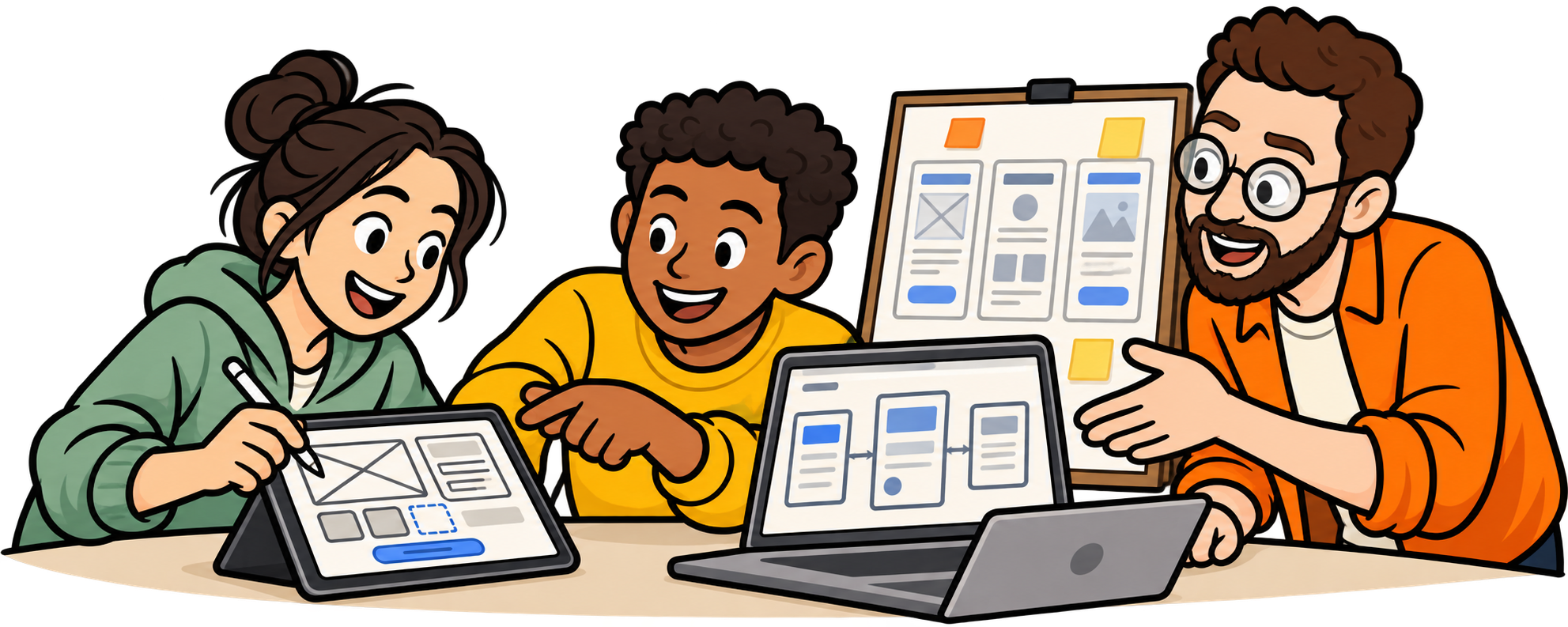
Interns needed real projects to practice on. Innovation ideas at OrangeWorks needed people to explore them. Designers wanted a way to learn mentoring, and a fellow Staff Designer came to me about building mentor training.
Delivery pressure kept pushing learning out. A missed concept got a faster answer, not a conversation.
I sourced the projects, developed the mentor materials and led the training workshops with engineering partners and innovation champions. The first cohort put 12 interns and 12 designer mentors in six teams.
Options explored
Three ways to run a mentor program.
We weighed how much structure mentors needed, and where they should spend their attention.
Key decisions
Protect learning. Ask first. Let mentors return and scale it.
Learning comes before the deadline
A missed concept mattered more than a polished presentation. Mentors had a clear basis for deciding when to slow a team down.
Ask where the work is stuck
“Let us know if you need help” put the burden on the intern. I trained mentors to ask instead.
Returning mentors train the next
They trained others, updated materials and helped scale operations.
Scale the structure, not the staff
The same board and the same prompts carried the program from six project teams to sixteen, across engineering, UX and product management.
How it ran
Check-ins, an unpacking day and a midpoint share-out.
My co-founder and I modeled the practice by joining check-ins, listening and asking questions. An unpacking day brought research, constraints, interview transcripts and experts together before teams proposed solutions.
Teams explored problem statements, sketches and low-fidelity prototypes, then presented their decisions to champions and stakeholders at the midpoint. They revised, coded and field-tested with customers and employees.
Outcome
From six teams to sixteen.
I helped run MEOW from 2019 until I left in 2022, and we adapted it for remote work in 2020. These outcomes reflect shared work with my co-founder, OrangeWorks partners, mentors, champions, participants and the hiring teams.
What I took forward
Leadership development needs a place to practice and habits that make uncertainty discussable. Real projects gave the context. Check-ins and feedback protected the learning.
Next case · Indeed Job Refresh